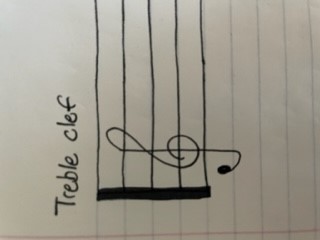
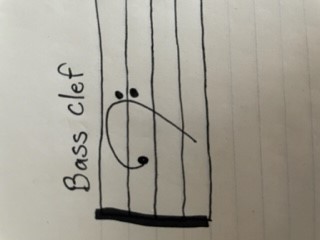
Look at the symbol at the beginning of the staff. If it looks like a worm on a hook, or a really fancy S, it's the treble clef. If it looks like a frowning face, or a backward C with a colon, it's the bass clef.
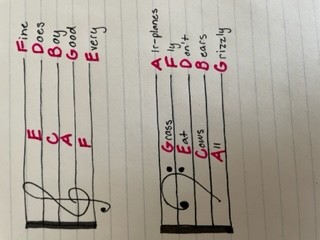
There are acronyms to the notes on the treble and base scale.
The lines on the treble scale are the notes E, G, B, D, and F, with the acronym being Every Good Boy Does Fine. With the spaces on the treble clef scale, the notes are F, A, C, and E. A simple way to remember this is space=face.
The lines on the bass scale are the notes G, B, G, F, and A, with the acronym being Grizzly Bears Don't Fly Air-planes. With the spaces on the base scale, the notes are A, C, E, and G. A way to remember this is All Cows Eat Grass.
Flats look like lowercase bs while sharps look like pound signs or hashtags. If there are no flats or sharps on the key signature, then the key is C major. This applies for both the treble and bass clef scale.


There are tricks to finding the key signature. These tricks are used on both the treble and bass scale, but the method is different if the key signature consists of flats or sharps.
If the key has flats, then where the second-to-last flat is is the name of the key and the starting pitch. If there is only one flat on the key signature then the key is F major.
If the key has sharps, then one step higher than the last sharp is the name of the key and the starting pitch.
