Languages require sounds (except for sign language or writing ). You can use the IPA (International Phonetic Alphabet) to choose sounds from.You can look at the examples to know which sound goes to which letter(image below).You can click on the link called "IPA examples" if you can't see the image below. There are also some links to some IPA-related pictures above and a page on articulation (click on Places and Manners of Articulation).
There are 28 different vowel sounds. You can choose a common vowel system, like the three-vowel system (a,i, and u) in some South American languages, or the five-vowel system (a,e,i,o,and u), which is in Spanish. You can also use diphthongs, which are a combination of two vowels. An example is the "i" sound in "ice", which, in IPA, is (ai).You can find other vowels to use by clicking on the link called IPA Vowels above.
Tone is a raise in sound to distinguish or to inflect words. Some languages that use tones are Chinese, Navajo, Burmese, Ancient Greek, and Punjabi. Depending on the language and region, there can be between 4 to 6 tones used, like high, rising, and falling. For example, in Chinese, "ma" with a flat tone means "mother", while "ma" with a rising & falling tone means "horse". In English,we use a high tone when we are asking questions.
Say the "s" sound in "sound", put two fingers on your throat, and hold it. Now, say the "z" sound in "zebra", put two fingers on your throat, and hold it. You will notice that when you're making the "z" sound, the throat is vibrating, while it doesn't when you make the "s" sound. The "z" sound is voiced, while the "s" sound is unvoiced, or voiceless. Some languages distinguish between voiced and unvoiced sounds, like English. Others
Sometimes sounds can be aspirated. That means that after a sound is made, a puff of air comes out. An example of this the "t" sound in "tall", but not the "t" sound in "star".You can tell this by putting your hand in front of your mouth when you say the words above.Some languages distinguish between aspirated and unaspirated sounds, like Ancient Greek. There are even breathy voiced sounds, which are aspirated voiced sounds, like in Hindi, and preaspirated sounds, which are aspirated BEFORE the sound is made, not after, which, for example, can be found in Icelandic.
Some sounds have a main articulation and a secondary articulation.The secondary articulation is usually an approximant and the place of the secondary articulation is where air is also blocked. An example of this is the "qu" sound in "question". Sounds that have a "w" sound after them, like the example above, is called labialization. Other common secondary articulations are palatalization ("m" sound in "music"), velarization ("l" sound in "fill", also found in Scottish Gaelic), and pharyngealization, (found in Arabic and other Middle East languages, both consonants and vowels).
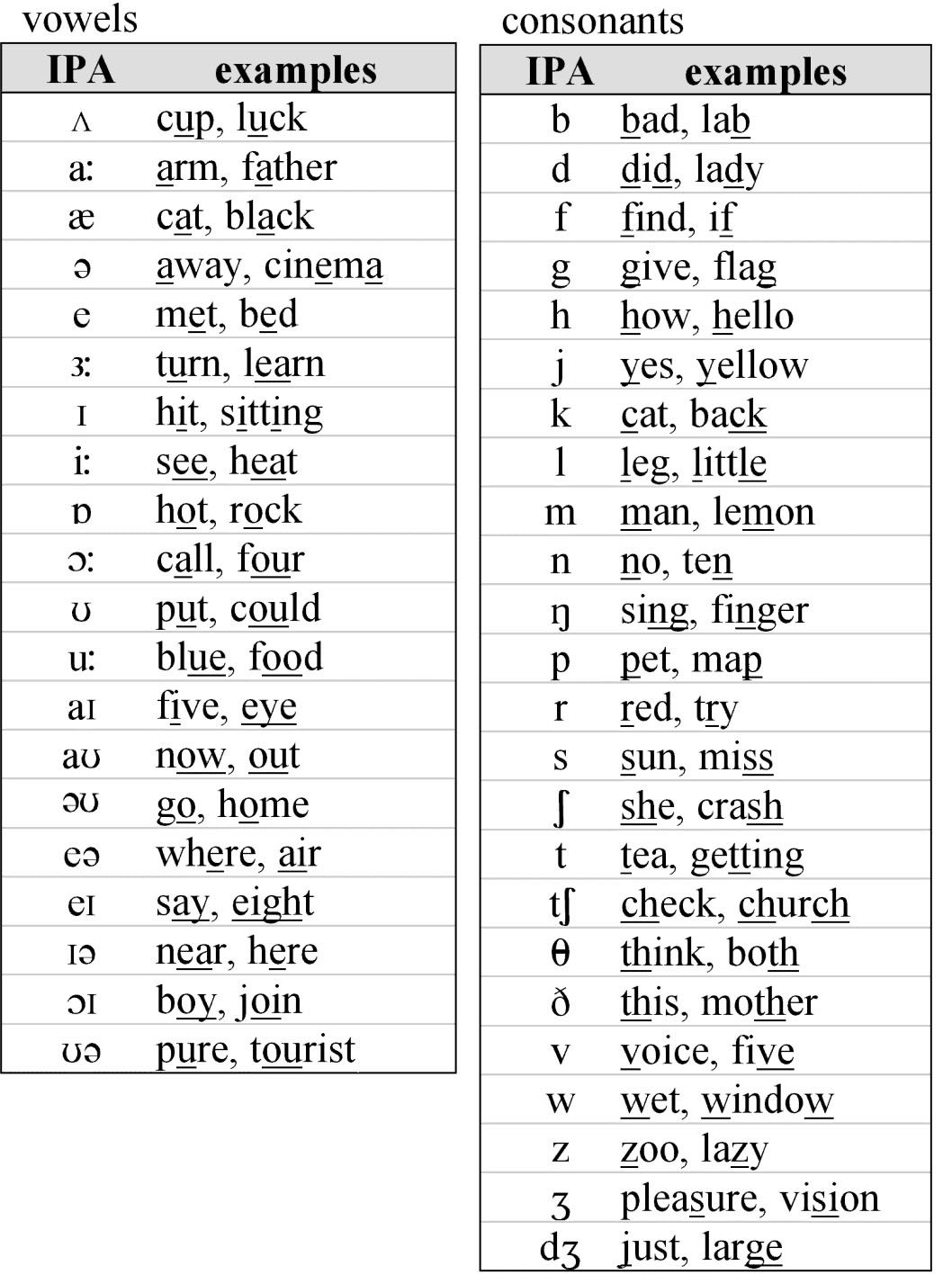
IPA Chart with English Examples by Mary E. Denton at pinterest.com CC
Non Pulmonic Consonants by International Phonetic Association on www.internationalphoneticassociation.org CC
Places of Articulation by LearnLanguagesOnYourOwn on learnlanguagesonyourown.com.
IPA chart by Ben Trawick-Smith on dialectblog.com CC
Ipa Chart by Hayley and Maider on happyhourspanish.com CC