Language Types
Conlang Types
Sounds
Home Page
Making Words
Syntax
Conjugation
Places and Manners of Articulation
Places and Manners of Articulation
This page will talk about places and manners of articulation. Place of articulation is where the sound is made, and manner of articulation is how the sound is made.(Note: IPA symbols or symbols used in other languages won't always show up here, so I have replaced them with similar symbols. Also, if you are confused about places of articulation, there is a picture below)
Place of Articulation
- Bilabial: Sounds made by both lips. Examples are the "p" sound in "pond" and the "m" sound in "man".
- Labiodental: Sounds made by the upper teeth and lower lip. Examples are the "f" sound in "fish" and the "v" sound in "van".
- Linguolabial: Sounds made by the tongue tip and the upper lip. An example is blowing a raspberry.
- Dental: Sounds made by the tongue against the back of the upper teeth. Examples are the "th" sound in "them" and and the "th" sound in "think"
- Alveolar: Sounds made by the tongue against the alveolar ridge. There are many alveolar sounds in English. Some examples are the "t" sound in "town", the "n" sound in and the "s" sound in "sound"
- Palato-alveolar: Like alveolar sounds, but farther back in the mouth. Examples are the "sh" sound in "ship" and the "si" sound in "vision"
- Retroflex: Sounds made by the tongue curling slightly on itself.Examples are the "ss" sound in the Polish word "kosse" and the "t" sound in "too", but with a slightly curved tongue
- Alveolo-Palatal: Like palato-alveolar sounds, but closer to the palate and farther from the alveolar ridge. Examples are the "tj" sound in the Swedish word "tjej" and the "j" sound in Japanese "jishin"
- Palatal: Sounds made by the middle of the tongue touching the palate. Examples are the "y" sound in "yell" and the "hu" sound in "hue".
- Velar: Sounds made by the back of the tongue against the velum. Examples are the "k" sound in "king" and the "ng" sound in "sing"
- Uvular: Sounds made by the back of the tongue against the uvula (the dangling thing on the top of the back of the mouth). Examples are the "r" sound in French "rendezvous" and the "q" sound in Chinook "qis"
- Pharyngeal: Sounds made by the back of the tongue touching the back of the throat. Examples are the "h" sound in Arabic "ha:l" or the "r" sound in Dutch "rad"
- Epiglottal: Sounds made by the epiglottal flaps touching the pharynx. Examples are the "Q" sound in Amis "QuQul" or the "x" sound in Haida "xants"
- Glottal: Sounds made at the glottis. Examples are the "h" sound in "hat" or the pause between "uh" and "oh" in "uh-oh"
Manner of Articulation
- Nasal: Sounds made by the air getting released through the nose. Examples are the "n" sound in "nose" and the "m" sound in "mouth"
- Stop: Sounds where the air is blocked at its place of articulation, then released.Examples are the "p" sound in "place", the "d" sound in "done", and the "k" sound in "kid".
- Fricative: Sounds where the air is forced to go through a narrow channel, making a hissing sound. Examples are the "s" sound in "sit", the "si" sound in "vision", and the "h" sound in "head"
- Affricate: A stop and a fricative said at the same time. Examples are the "ts" sound in "cats" and the "j" sound in "judge".
- Approximants: Sounds where the air flows smoothly through the mouth without an obstruction. Usually forms from a vowel. Examples are the "w" sound in "wait" and the "y" sound in "yellow".
- Taps: Similar to stops, but with less pressure and time used to make them. Examples are the "tt" sound in "battle" or the "d" sound in Warlpiri "dupa".
- Trills: A series of repeated, rumbling bursts. Examples are the "rr" sound in Spanish "carra" and the "r" sound in French "rendezvous"
- Lateral Approximants: Sounds where the air goes around the tongue. Examples are the "l" sound in "laugh" and the "ll" sound in "bell".
- Lateral Fricatives: A combination of a lateral approximant and a fricative. Examples are the Welsh "ll" sound and the "dl" sound in Zulu "indlala"
- Lateral Flaps: A combination of a lateral approximant and a flap. Examples are the "r" sound in Japanese "roku" and the "l" sound in Kannada "ke:li:"
Non-Pulmonic Sounds
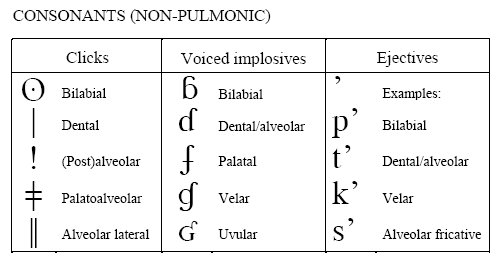
These are sounds that are made by air that isn't from the lungs. The sounds above are pulmonic, or made by air from the lungs.
- Clicks: Sounds formed by a sudden burst of air. Examples are the "tut tut" sound in English or the "q" sound in Hadza "laqo"
- Ejectives: Sounds made by a stream of air from the glottis. Examples are the "p'" sound in Quechua "p'acha" or the "ts'" sound in Georgian "ts'eli".
- Implosives: Sounds that is made from air from the glottis and the lungs. Examples are the "d" sound in Jamaican "dem" or the "k" sound in Zulu "ukuza".
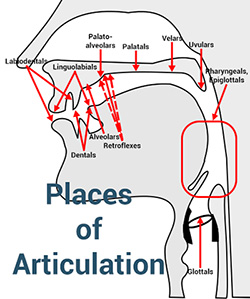
Places of Articulation by LearnLanguagesOnYourOwn on learnlanguagesonyourown.com.
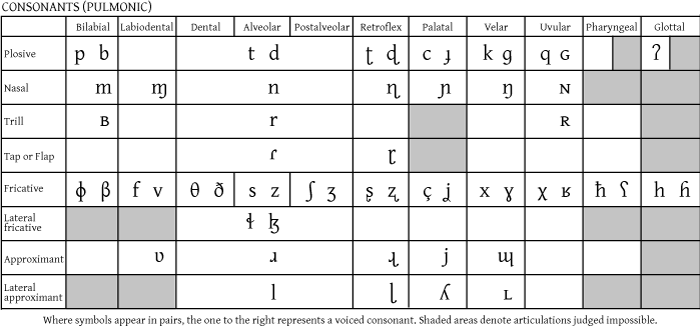
IPA chart by Ben Trawick-Smith on dialectblog.com CC